Donald Bruce was born in Middlesex, Massachusetts in 1884. After graduating from Yale in 1906 and teaching mathematics for two years, Bruce returned to Yale to enter the Forestry School and graduated in 1910. After graduation he passed the civil service exam and joined the Forest Service on July 1, 1910 as forest assistant on the Helena and Coeur d’Alene National Forests before transferring to the District 1 headquarters in Missoula, Montana. In 1913, he became Forest Supervisor on the Flathead National Forest in Montana.
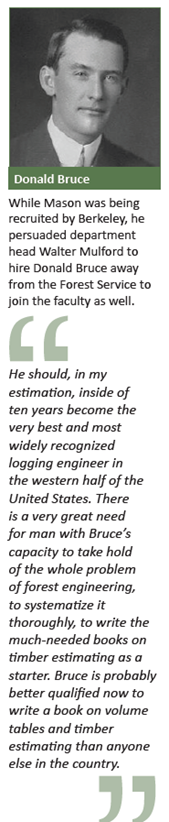
Bruce was a longtime friend and associate of Mason, having first met when they served together in the USFS in Montana between 1910–1914. When Mason joined the faculty at Berkeley, he persuaded the department head to recruit Bruce to the faculty as well. In 1924 he left the faculty to rejoin the USFS in Washington, D.C. as an expert on forest measurements. Bruce eventually joined the firm full time in 1931 after working part time from the east coast since 1925.
In the 1920s it was common practice for cruisers to leave very little evidence, if any, of the work that been done in the field. Bruce was part of the influential team who thought cruising ought to be done so that the work could be audited. He helped develop a system by which cruise cards were kept for each sample plot with directions to the location of the plot. For each plot on the ground, a witness tree was marked near the center of the plot and an aluminum knitting needle, chosen because they were easy to carry, was pushed into the ground at the center. The distance and bearing from the witness tree to the knitting needle were then recorded so that the plot center could be easily relocated. In this way it was possible for a second cruiser to “make a very convincing check of the cruise.” Although more expensive, the practice caught on.
Donald Bruce served 41 years at Mason, Bruce & Girard and his legacy of a high level of analytical rigor and expertise is still influential at the company today.
While conducting stand exams for the Upper Grouse Valley Project in California, MB&G foresters Ande Myers, Ian Cummins, and Rubie Teffeteller came across these impressive giant puffball mushrooms.
READ MOREMB&G is supporting PG&E with a hazard tree patrol to identify dead and dying trees along the Salt Springs/Tiger Creek Canal system in California. The canal system’s primary purpose is to supply water for hydropower generation. As the water continues downstream, it also becomes a source of drinking water for local utility districts. These historic canals have played an important role in Amador County for decades and present a unique environment for forestry work. Projects like this highlight the diverse and specialized work our California forestry team performs across the state.
READ MORECruise data collection has evolved, but many organizations are still relying on outdated software and hardware that weren’t built for modern forestry workflows. MBG T2 Mobile was developed to change that. Watch the video below to see MBG T2 Mobile in action and learn how it’s helping forestry professionals collect better data, more efficiently.
READ MORE