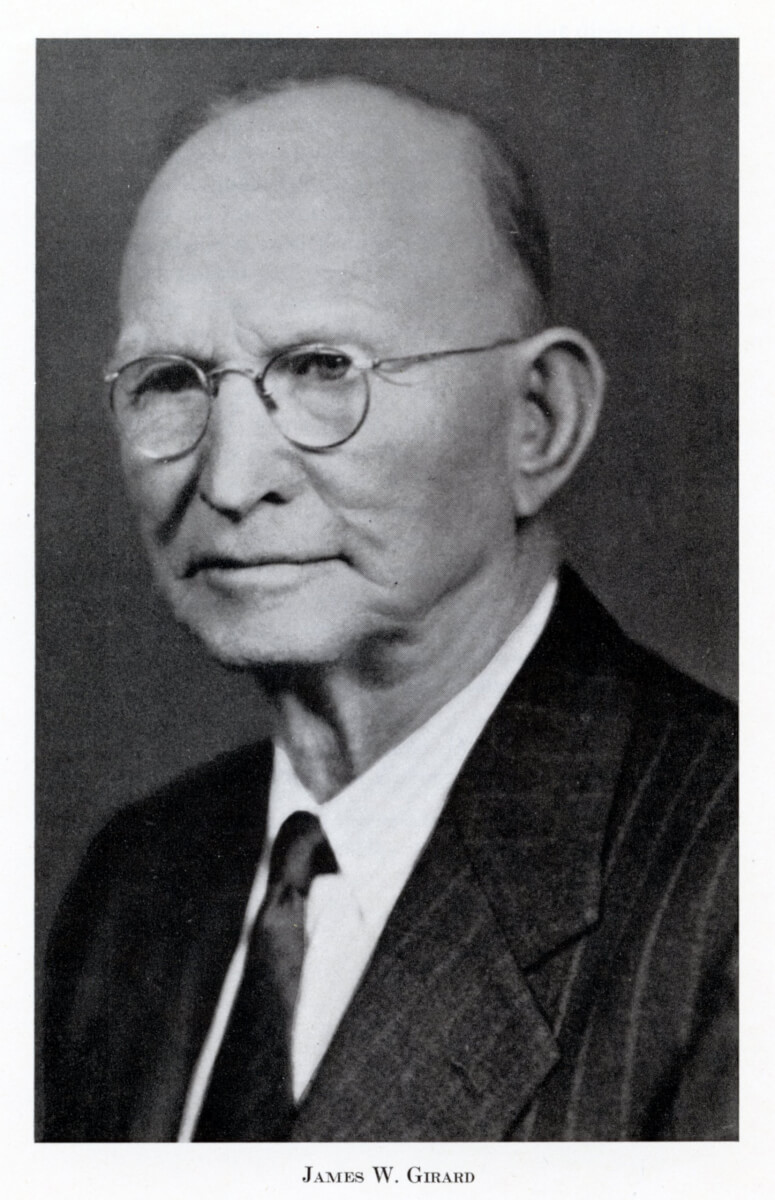
As part of our 100-year anniversary series we are taking time to highlight our firm’s three founding members. This month we are highlighted James “Jim” Walter Girard. Girard was born in Pleasant View, Tennessee on March 4, 1877. His early work in forestry began with his career in the United States Forest Service, where he became known as the “patriarch of timber cruising.” In 1897, Girard compiled his work in the second timber volume table ever produced in the United States and, by the age of twenty, he was cruising timber for sawmills in Wyoming, Idaho, Indiana, and North Dakota. He joined the new USFS in February 1908, scaling logs and marking timber for the Anaconda timber sale in Seeley Lake, Montana. This was the largest timber sale the USFS had ever made, of some fifty million board feet, and was purchased by Anaconda Mining. Girard worked on the timber sale from 1908 to 1910.
Girard advanced quickly, becoming a ranger and, then in 1915, a logging engineer. Due to his unique experience as a timber cruiser, the USFS gave him special assignments as a troubleshooter throughout the Pacific Northwest. In 1921, while assigned to headquarters in Washington, D.C., he rewrote the USFS National Stumpage Appraisal Manual, which established guidelines for timber sales on national forests and a points system that is still used today to calculate a tree’s size. It became known within the agency as the “appraiser’s Bible.” In 1939, Girard co-authored the book Timber Cruising based upon his own professional experience.
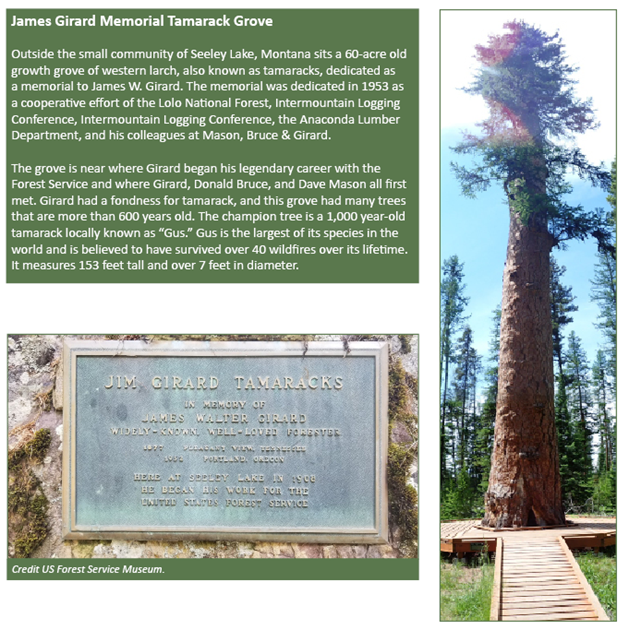
In January 1946, Girard joined the firm full-time as a partner. Girard and his long-time friend, Don Bruce, soon collaborated to produce the “Girard Form Class” volume tables for which the firm is still well known. Girard was a self-made professional forester. “He was an unusually thoughtful man, an inquiring man,” David Mason recalled, “he wanted to find out the reasons for things and do things that would make his work easier. He was an inventive person.” Girard passed away in November 1952 at the age of seventy-five. His seven short years with the company made a lasting, positive impact on its operations and reputation. The James Girard Memorial Tamarack Grove is dedicated to him outside the small community of Seeley Lake, Montana.
MB&G is excited to be at the Society of American Foresters National Convention in Tacoma, WA this week.
READ MOREMB&G’s Emmaline Bryant will be playing in the Parker Memorial Golf Tournament on Friday. Since 2008, Warnell’s Young Alumni Committee has raised more than $600,000 for the school through the golf tournament with support from the family of J. Reid Parker. As a Platinum sponsor this year, MB&G is pleased to support the school’s goal of increasing opportunities for experiential learning.
READ MORE